

Leading enterprises trust cidaas
From SMEs to large international corporations – cidaas protects millions of digital identities across Europe.












Identity needs organizational context
B2B IAM connects a person with the customer group they belong to and the roles they hold within that context. The same user profile can therefore have different access levels, permissions and responsibilities across several customer organizations.
Identity alone is not enough. Group membership gives each person the organizational context in which their role applies.
Manage customers as organizations, not collections of accounts
One customer organization can be modeled as a group structure that reflects how the business is organized.
A customer may contain subsidiaries and locations. Members and roles stay connected to the correct level of that organizational context.
Let customer admins manage users within your rules
Customer admins can invite and remove users, manage memberships and assign the roles made available to them. The platform owner defines the boundaries and allowed roles.
Delegated user administration becomes part of the product experience, close to the people who know who should have access.
One B2B IAM. Different ways to bring users in.
Customers can add users in cidaas B2B IAM through self-service, invitation or Enterprise SSO. All three routes end in the same customer-group structure and role model. Whatever the entry point, the identity lands in the same organizational framework and is governed by the same roles and policies.
Integrate customer identity providers, applications and business services through standards such as OpenID Connect, OAuth 2.0, SAML and SCIM. JIT provisioning, APIs, directory synchronisation and webhooks help automate identity data and user access across connected systems. For more complex environments, identity orchestration via the cnips iPaaS can connect onboarding, provisioning and access permissions across multiple application, organizations and data sources.
One identity. Multiple customer contexts.
A single identity may belong to several customer organizations, tenants or subsidiaries, while retaining a different role and level of access in each context. Selecting the active context determines the role that applies. This supports secure cross-organizational collaboration without creating disconnected user accounts for every company, team or business unit.
The following provides an example of a B2B IAM user with multiple contexts:
Select the role or team you're working in. Your access and permissions will change with the selected context.
Works across multiple teams at a manufacturing company.
John Smith is a Managing Director in Customer Group A, with access to company-wide administration and approvals.
Keep customer access current
Customer access starts with onboarding, is periodically reviewed where required, and ends through local removal or a connected customer lifecycle. A B2B customer lifecycle in cidaas can look like the following:
Add users through self-service, invitation or federation.
One-time passwords by email or phone, push notifications, authenticator apps, mobile biometrics and FIDO certified authenticators including passkeys.
Role, attribute and Policy-based Access Control. The group type defines the available roles.
Customer User Management throughout their lifecycle, including changes to roles, group memberships and access rights.
Confirmation of memberships and roles.
Local removal of access or via the customer’s identity lifecycle (depending on the integration model).
B2B IAM use cases
for digital products and platforms
B2B SaaS platforms
Each business customer operates within its own tenant, with dedicated groups and users, administrators and roles.
B2B e-commerce platforms
A business customer gets its own group on your shop. Administrators add colleagues and give each one a role. One places orders, one collects them, one sees the invoices.
Business service platforms
Configurators, procurement portals and service portals are used by teams, not by single logins. Each business customer manages its own team: who may configure, who may submit, who may only view.
cidaas is recognized as a Leader in B2B IAM
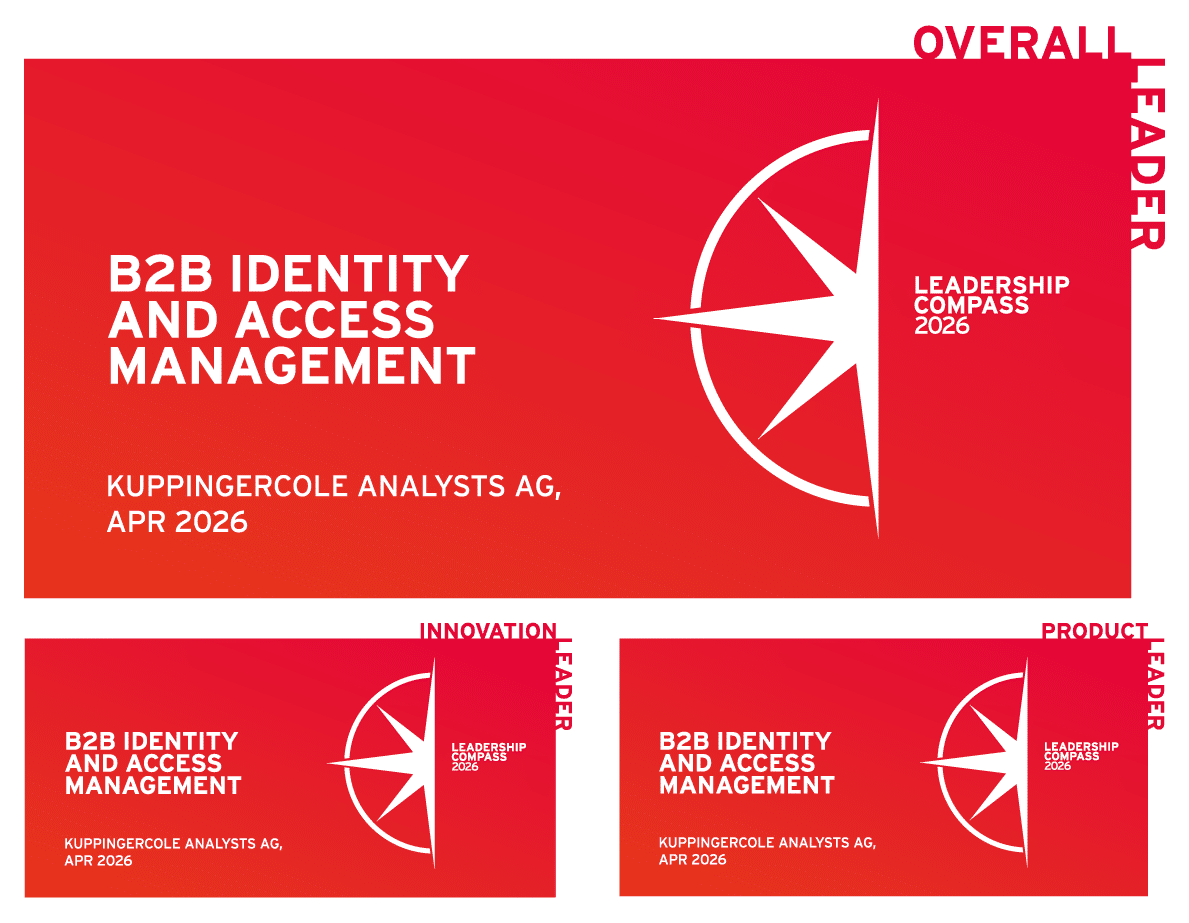
KuppingerCole have recognized cidaas as Overall Leader, Product Leader and Innovation Leader in the B2B IAM Leadership Compass 2026. Delegated administration is one of the evaluated core criteria.
Why choose cidaas B2B IAM?
Built around organizations
Organizations, groups and administrative boundaries are part of the identity model.
Customer identity sources
Self-service, local identities and customer federation can coexist.
Authorization with context
Organizational context can inform access decisions.
European SaaS platform
Headquarted in Germany, hosted in the EU. ISO 27001 certified.
Make every customer organization part of your digital product
Give business customers their own users, administrators, Identity Providers and access contexts while your platform keeps control of the framework.